5 min read
Houston Apartment Fires: Does Your Complex Have a Fire Alarm System or Just Smoke Alarms?
 DSC
:
October 26, 2026
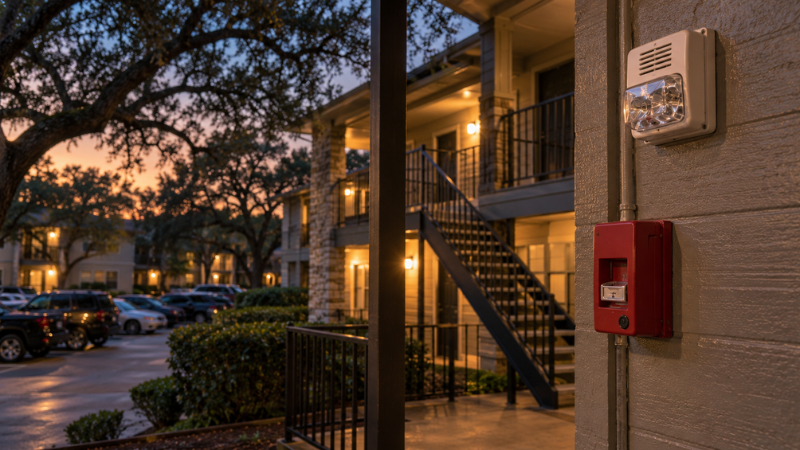
On the afternoon of October 16, 2026, a fire started on a second-floor balcony at an apartment complex on Forum Park Drive in southwest Houston. Wind pushed it up through the roof. Twelve units were damaged. One resident told reporters he smelled smoke, and then someone knocked on his door.
That knock is the question for every property manager in Houston right now. If a fire starts in a neighbor's unit, on a balcony, or in the attic, what tells your residents to get out? In many Houston garden-style complexes, the honest answer is only the smoke alarm inside each apartment. That alarm sounds in that apartment. It does not warn the building.
That may be all the code requires for your property. But you should know which kind of protection you have before the next fire, not after.
Houston apartment fires in October 2026
The Forum Park fire was not the only one. In about ten days, the Houston area saw at least four multi-unit fires:
- Around October 11: A two-alarm fire at West Oaks Landing Apartments in southwest Harris County partly collapsed a second floor.
- October 14: A fire that started on a second floor just after 1 a.m. damaged 12 units at Walnut Creek Apartments in north Houston.
- October 16: The Forum Park Drive fire damaged 12 units. HFD said wind and a broken fire hydrant complicated the response.
- October 20: A fire on Braesvalley Drive spread to three buildings and injured a firefighter. The units were vacant.
No residents died in these four fires. Causes are still under investigation, and none of the reports say whether alarms worked or failed. This article doesn't assume they did. The point is simpler: fires like these start at hours and in places where nobody is watching.
The difference between a smoke alarm and a fire alarm system?
A smoke alarm is a single device that detects smoke and sounds its own horn. It warns the people in that apartment. A fire alarm system is a network of devices wired to a control panel. When one device trips, horns and strobes sound across the whole building, and the system can call a monitoring center that sends the fire department.
Most Houston apartment residents have smoke alarms. Fewer live in buildings with a full fire alarm system. Older garden-style complexes, the two- and three-story buildings with outdoor stairs and breezeways, often have only smoke alarms.
The gap matters most at night. If the fire is next door, your residents' own alarms stay quiet until smoke reaches their unit.
Does a Houston apartment building need a fire alarm system?
It depends on the building's size, layout, and age, and on which fire code applies. The City of Houston uses the 2021 International Fire Code, adopted by Ordinance No. 2023-9071, effective January 1, 2024. Unincorporated Harris County adopted the 2021 IFC effective January 1, 2025.
Under the 2021 code, a new apartment building generally needs a manual fire alarm system if any unit is three or more stories above the lowest exit level, or if the building has more than 16 units. But there are exceptions that often apply to garden-style buildings, such as when every apartment opens straight to the outside and fire-rated walls separate the units, or when the building has sprinklers. The code has a separate set of rules for existing apartment buildings.
So a two-story building with 12 units and outdoor stairs may legally need nothing more than smoke alarms. Your local fire marshal has the final word for your property. That's HFD inside Houston city limits, or the Harris County Fire Marshal's Office in unincorporated areas.
What Texas law requires landlords to do about smoke alarms
Texas law sets the floor for smoke alarms inside rental units. Under Texas Property Code §92.255, a landlord must put at least one smoke alarm in each bedroom. A unit with more than one level needs one on each level.
The landlord must make sure each alarm works at move-in. After that, the landlord must inspect or repair an alarm when a tenant asks or reports a problem (§92.258). Units that were occupied or got a certificate of occupancy before September 1, 2011, may use battery-powered alarms that aren't linked together.
These are legal duties, and the details matter. Talk with your attorney about how they apply to your property. What's useful here is the practical part: in many older Houston complexes, the only warning system is a battery alarm that may or may not have a working battery.
Why balcony and attic fires can get ahead of smoke alarms
Smoke alarms live inside apartments. Two of the October fires started or spread where those alarms can't sense them: one on a balcony, and others through roofs and shared attics.
Many garden-style buildings share one open attic across several units. A fire that reaches it can travel over the ceilings of apartments whose smoke alarms haven't sensed anything yet. By the time smoke pushes down into a unit, the fire may be well ahead.
To be clear about what an alarm can't do: no alarm system stops a fire from spreading. Sprinklers, fire-rated walls, and attic draft stops do that. An alarm buys time to get out, which is what the neighbor's knock did on Forum Park Drive.
Options when your apartment building has only smoke alarms
If your property relies on smoke alarms alone, you have choices between "do nothing" and "rewire everything."
- Upgrade to hardwired, linked smoke alarms within each unit. When one sounds, they all sound in that apartment. That helps residents in larger units hear it from any bedroom.
- Add a building-wide fire alarm system. Horns and strobes in every unit or breezeway warn the whole building at once. This is the biggest step and the biggest cost.
- Add monitoring. A monitored system calls for help even when no resident is awake or home, as in the vacant Braesvalley units.
- Ask about detection in attics and other spaces. Whether it fits your building is a design question for a licensed fire alarm designer and your fire marshal.
DSC designs, installs, and inspects commercial fire alarm systems for apartment communities, HOAs, and other multifamily properties across Houston. We'll tell you what your building needs and what's optional, and we won't sell you a system the property doesn't need.
Checklist: what to check at your Houston apartment community
Use this list after a fire in your area, or any time you take over a new property.
- Know what you have. Walk one building. Are there pull stations, horns, or strobes? Is there a fire alarm panel? If not, you rely on smoke alarms.
- Pull your move-in test records. Can you show each unit's smoke alarms were tested at move-in?
- Search your work orders. Look for open tenant reports about beeping, missing, or broken smoke alarms. Close them first.
- Find your last fire alarm inspection report, if you have a system. Read the deficiency list, not just the cover page. Here's how often a commercial fire alarm must be inspected in Texas.
- Check the panel. A panel showing "trouble" or "supervisory" for weeks is a system that may not work when needed.
- Confirm monitoring contacts. Make sure the monitoring company has current after-hours phone numbers for your staff.
- Review your grill rule. HFD's Fire Marshal FAQ notes a lease may ban cooking devices within 10 feet of the building. Decide your rule, then enforce it.
- Keep fire lanes clear. Houston's high-risk apartment inspection program, launched July 31, 2026, singles out blocked fire lanes and broken fire alarms as serious problems.
- Check who services your system. Fire alarm companies must be registered with the State Fire Marshal's Office. Here's how to check a fire alarm company's license in Texas.
Talk to DSC about your apartment community
If the October fires made you wonder what would warn your residents, start with a walk-through. DSC works with property managers and HOAs in Houston to survey existing systems, explain what code requires, and price practical upgrades. We also handle fire alarm inspections for properties that already have a system.
Contact DSC to schedule a visit. We'd rather help you find a gap on a quiet Tuesday than after a knock on the door.