4 min read

How Retail Theft Rings Work in Texas & What Actually Slows Them Down

How Retail Theft Rings Work in Texas & What Actually Slows Them Down

Steal to Order: How Retail Theft Rings Work in Texas — and What Actually Slows Them Down

Last month, League City police wrapped up an investigation that started with a single store complaint and ended with more than 15,000 stolen items recovered. The total value was over $400,000. The list of stores hit reads like a strip-center directory: Academy, Ulta, Bath & Body Works, CVS, Home Depot, Kohl's, lululemon, Randalls, Sephora, Target, TJ Maxx, Victoria's Secret, Walgreens, and Walmart.

The investigation took eleven days.

That case is not unusual anymore. It is what retail theft looks like in the Gulf Coast region right now. And if you manage a store, a shopping center, a distribution site, or a multi-site retail brand in Texas, it is worth understanding how these groups actually operate. Because the answer is not "more cameras." The answer is better information.

This is not shoplifting

There is a real difference between a person who pockets a candy bar and a crew that empties a shelf on request.

Court records from a southwest Houston case show how the second kind works. Investigators say a woman ran the operation out of an apartment on Fondren Road. She did not steal anything herself. She placed orders. Text messages showed her asking for specific products — vitamins, cosmetics, hair products, baby wipes, even Stanley cups. Then she sent other people out to get them.

They were, in the plainest terms, taking orders from a shopping list.

In one documented trip, two men walked out of a store with more than $2,000 in vitamins without stopping at a register. Outside the apartment, investigators photographed dozens of discarded anti-theft devices in the trash. Someone was sitting there removing tags in bulk.

That is a supply chain. It has a buyer, runners, a staging location, and a resale channel. And it is treated differently under Texas law. Penal Code 31.16 covers organized retail theft, and the value of the merchandise drives the charge. Once the total passes $300,000, it becomes a first-degree felony — five years to life. The woman arrested in the League City case is facing exactly that.

The numbers most retailers do not see

The National Retail Federation's 2026 study found something that surprises people: shoplifting incidents actually dropped 12.4% last year, and merchandise theft fell 8.1%. Good news, on the surface.

But dig into the same study and the picture changes. Half of retailers reported repeat offenders. Forty percent reported organized retail crime incidents. And 63% of retailers said they report fewer than half of their theft incidents to police at all. The most common reasons? The dollar loss was too low to matter, or they did not expect follow-through.

That last number is the one that should stop you. When most incidents never get reported, the individual losses stay small and forgettable — and the pattern stays invisible.

Data from the retail crime platform Auror shows how much that pattern matters. In Texas, the top 10% of offenders account for more than 71% of retail crime. The national figure is 66%. A small number of people are doing most of the damage, and they are doing it across many stores.

Auror's data also found that about one in eight retail crime events involves violence, weapons, or threatening behavior — and repeat offenders are more than twice as likely to be the ones escalating. This is no longer only a loss problem. It is a staff safety problem.

What broke the League City case

Here is the part worth paying attention to. Police did not solve that case by watching more video. They solved it by connecting video across locations and jurisdictions.

License plate reader cameras let detectives identify vehicles tied to the group, figure out when League City businesses were being targeted, and link thefts at retailers in other cities. Six different agencies and associations ended up involved, including Houston PD, Pearland PD, Texas DPS, and the Texas Organized Retail Crime Association.

One store's camera footage shows an incident. Many stores' footage, tied together with vehicle and timing data, shows an operation.

What this means for your facility

We are a systems integrator, not a loss prevention consultant, so we will stay in our lane. But there are practical, technical gaps we see constantly when we walk retail and multi-tenant sites in the Houston area:

Footage that documents instead of identifies. A wide shot of an aisle proves something happened. It rarely tells you who. Camera placement at entrances, exits, and registers — at face height, with enough resolution to hold up — is what makes footage usable to an investigator.

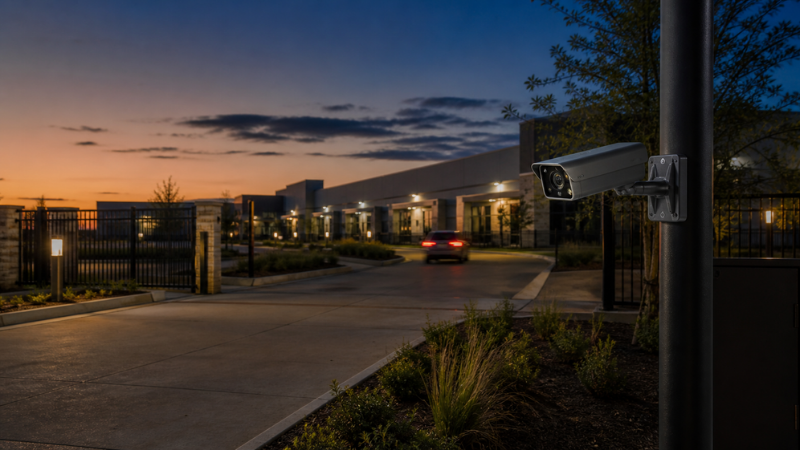
No coverage of the parking lot. The vehicle is often the most useful piece of evidence in an organized case, and it is the piece most retailers do not capture. Exterior cameras covering lot entrances and exits matter more than most people expect.

Video that lives on an island. If each store records to its own recorder and no one can view multiple sites in one place, you cannot spot a crew hitting three of your locations in one afternoon. Cloud or centrally managed video changes that.

Footage that expires before anyone asks. Investigations take weeks. Retention set to seven or fourteen days means the video is gone by the time police call. This is a settings problem, and it is usually free to fix.

Doors nobody is watching. Emergency exits and back-of-house doors are common exit routes in these cases. Door position monitoring and alarm integration turn a quiet exit into an alert.

A system nobody has checked in a year. Cameras drift out of focus. Hard drives fail silently. We find offline channels on nearly every site survey we do. A working system you can prove is working is the whole point.

A reasonable next step

If you are not sure what your cameras would actually give a detective, find out before you need to know. Pull footage from a random afternoon three weeks ago at one of your sites. Can you read a license plate? Can you see a face at the door? Is the video still there?

That one exercise tells you more than any brochure will.

If the answer is not what you hoped, we are glad to walk your site and tell you plainly what would help and what would not. Some of these fixes are configuration changes, not purchases. We would rather tell you that than sell you something you do not need.

Call us at (713) 464-8407 or reach out at info@thinkdsc.com.